On most mid-rise multifamily jobs, insurance sits in the developer’s or owner’s bucket. Framing gets priced in the GC’s. Those costs almost never show up in the same meeting, so the link between structural system and underwriting—builder’s risk, permanent property, how many carriers it takes to hit a lender’s limit—gets missed. After 40+ years designing, prefabricating, and installing cold-formed steel, I still see teams treat framing as a stud line item and insurance as someone else’s problem. This piece is the connection those separate buckets tend to hide: how combustible versus non-combustible framing shows up in the insurance file, with the public numbers from NFPA, SFIA, and IBHS.
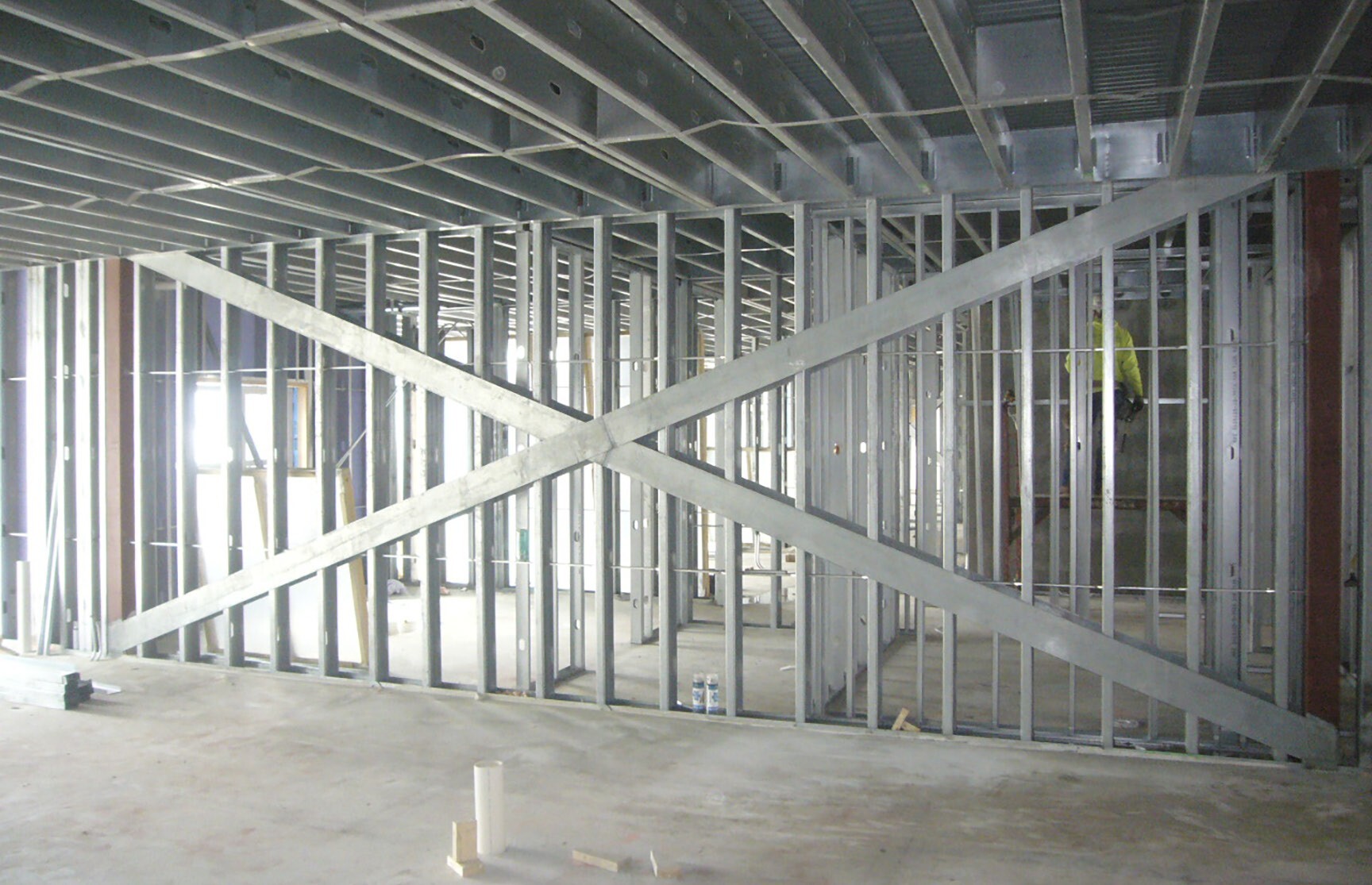
NFPA’s Home Structure Fires research treats “home” as one- or two-family dwellings and apartments or other multifamily housing. In 2023, NFPA estimated about 76,500 apartment or other multifamily fires—down from 80,000 in 2022 and part of a longer decline. The death rate per 1,000 reported apartment fires was 5.2, against 8.7 for home fires overall. Those apartment numbers look better for a reason: apartments are more regulated, more likely to have sprinklers, and more likely to report minor cooking fires that never leave the kitchen. Sprinklers, when present and operating on fires large enough to activate them, cut civilian death rates sharply in NFPA’s tables—on the order of an 89% reduction when sprinklers are present regardless of operation in the home-structure analysis. That is life-safety progress. It is not a full answer for a mid-rise still under construction, when the sprinkler system is incomplete and the framing is still exposed. (NFPA Home Structure Fires; PDF: oshomes.pdf.)
What the insurance file actually prices
Carriers do not underwrite “apartments” as a single class. They underwrite combustible versus non-combustible structure, stage of construction, and how many layers of coverage they have to stack to hit the required limit. The Steel Framing Industry Association has published illustrative builder’s-risk and property comparisons that show how large that gap can get on paper. In one SFIA sample—a four-story, 400-unit hotel at $120 million construction value—builder’s risk on a wood frame ran roughly $0.60–$0.80 per $100 of construction value; cold-formed steel sat closer to $0.12–$0.18. Using midpoints over a two-year build, that worked out to about $1.68 million on wood versus $360,000 on CFS—an illustrative $1.32 million difference on builder’s risk alone. The same sample put annual property premiums lower on steel as well, compounding over a hold period. Other SFIA illustrations (smaller hotels, concrete-to-CFS comparisons) point the same direction: non-combustible framing is one of the variables underwriting models actually price. (SFIA, Insurance Savings with CFS.)
Those are industry illustrations, not Wall-tech quotes and not a promise that every multifamily deal will clear the same spread. What they explain is why structural system shows up in a lender’s insurance review before lobby finishes do. Coverage capacity matters too. When a single carrier will only put $5–7.5 million on a combustible mid-rise and the loan requires $25 million, the developer pays for a stack of policies. Non-combustible construction tends to open more of that capacity in one place. That is a closing cost and a closing risk—usually invisible to the GC who bid the studs.
SFIA’s illustrations also cover permanent property and multi-year hold math. In that same 400-unit hotel sample, annual property premiums on wood ran roughly $0.12–$0.14 per $100 of final value versus about $0.07–$0.08 on CFS. Midpoint annual savings around $66,000 compound to roughly $660,000 over a ten-year hold in the illustration—on top of the builder’s-risk delta. A separate SFIA concrete-versus-CFS hotel example put annual property lower on CFS by about $300,000, with a note that builder’s risk and workers’ compensation moved as well. Again: illustrations for reading the underwriting file, not a Wall-tech premium quote. They are the kinds of sheets a broker can run against a real address.
Capacity stacking is where developers feel the friction at closing. When combustible mid-rise forces three or four carriers to reach a $25 million requirement, each layer adds premium, negotiation time, and a chance the stack falls apart late. Non-combustible structure does not guarantee a single-carrier quote. It does change how many doors the broker may have to knock on before the lender signs off.
Construction-phase risk is a different animal
SFIA’s mid-rise fire document makes a point fire marshals already know: residential sprinkler trade-offs and podium allowances changed how tall combustible framing can go, but sprinklers are not running during the open-frame months. Documented multi-story wood-frame losses during construction—hotels, apartments, senior housing—show how fast an unfinished combustible structure can go. Steel does not add fuel the way a wood frame does. That does not make concrete or wood “bad” materials; both have jobs they do well. It does mean CFS is non-combustible by nature, which is the attribute underwriting and AHJs keep circling. The document’s point is not that every wood mid-rise fails. Construction-phase exposure—open framing, incomplete sprinklers, adjacent property risk—keeps showing up in total-loss fires that steel and concrete buildings of similar size have not matched. A neighboring job that burns is often what finally puts framing type on a developer’s radar—not a weekly call to the panel fabricator. (SFIA, Fire Safety in Mid-Rise Construction.)
On occupied mid-rise, the same attribute shows up in remodel and repair scopes. A welding or grinding incident in a steel-framed corridor is still a serious event. It is a different event from fire traveling through unfinished wood cavities. The difference belongs in the risk file whether or not anyone is shopping studs that week.
Don’t bash wood or concrete in the loan package. Bash incomplete risk narratives. A clear non-combustible structural story, backed by SFIA’s fire and insurance materials and the NFPA life-safety context, is easier for a credit committee to underwrite than a vague claim that “steel is safer.”
Wildfire standards are entering the multifamily conversation
IBHS’s Wildfire Prepared Home program is no longer just a single-family checklist. The technical standard now runs Essential and Enhanced (Plus) tracks covering roof covering, vents, ember-resistant details, a six-inch vertical noncombustible wall-covering clearance at grade, and defensible-space zones. IBHS has also published a Wildfire Prepared Multifamily path so apartment owners can work toward the same kind of designation language carriers already recognize on the single-family side. Framing is only one piece of that package—cladding, vents, decks, and the five-foot noncombustible zone matter just as much—but a non-combustible structural grid makes the rest of the assembly easier to place in a coherent underwriting narrative. (IBHS Wildfire Prepared Home standard; Wildfire Prepared Multifamily.)
Essential-level IBHS items that show up first on multifamily checklists include Class A roof coverings, ember-resistant vents, cleaned gutters, that six-inch noncombustible vertical clearance at the base of exterior walls, and a managed 0–5 foot noncombustible zone. Plus/Enhanced adds tighter rules on eaves and soffits, exterior wall coverings, tempered or multipane exterior glass, and under-projection details. Framing alone does not check those boxes. A non-combustible grid does make it less awkward to argue that the rest of the assembly belongs in a wildfire-aware binder.
A CFS frame alone does not earn a wildfire designation. Ember entry at vents and deck details still decide a lot of claims. What the framing choice does is either support or undercut the rest of the story when the IBHS checklist and the structural narrative sit in the same binder. That is a technical connection worth making early—not because anyone is calling the framer about premiums, but because the developer is the one who will pay them.
Connecting framing to the insurance file
Wall-tech’s work is design, prefabrication, and install of CFS systems for mid-rise multifamily—not placing coverage. Details on how we run design through install and a cross-section of finished mid-rise sit on our projects page. For a narrower height-band comparison, see Cold-Formed Steel vs. Wood Framing for 4–12 Story Buildings: Cost, Schedule, Fire, and Insurance. Developers weighing CFS for story count, unit mix, or schedule often start with Why Multifamily Developers Are Looking Harder at Cold-Formed Steel. Prefab schedule effects that feed carrying-cost math are in What a Prefab CFS Crew Actually Changes on the Deck and Prefab CFS on Mid-Rise Multifamily: Labor, Codes, and Carrying Costs.
None of that replaces a broker’s quote on a specific address. Climate, AHJ, replacement-cost valuation, and claims history still move the number. The framing system is still one of the few variables the development team controls before the binder goes out—even when the GC’s bid set never mentions insurance.
What to do with the split buckets
If the deal is mid-rise multifamily, ask your broker—not your framer—for builder’s-risk and permanent-property indications on combustible versus non-combustible framing before design is frozen. Ask what limit the lender needs and how many carriers it may take to stack that limit on each option. Treat the structural system as part of the capital stack, not as a late VE item the GC prices in isolation. CFS is one way to change what that file looks like. It is not the only material that belongs on mid-rise, and wood and concrete still earn their keep where height, load, and local practice say so.
If you want a Wall-tech read on framing for a specific mid-rise—stories, unit mix, schedule, and whether prefabricated CFS belongs in the package—start at Contact. Bring the drawings and the dates. Send the insurance questions to your broker.
Sources
• NFPA, Home Structure Fires (research page): https://www.nfpa.org/education-and-research/research/nfpa-research/fire-statistical-reports/home-structure-fires
• NFPA, Home Structure Fires PDF (oshomes): https://content.nfpa.org/-/media/Project/Storefront/Catalog/Files/Research/NFPA-Research/Building-and-life-safety/oshomes.pdf
• SFIA, Insurance Savings with CFS: https://sfia.memberclicks.net/assets/Firestructures/Insurance%20Savings%20with%20CFS%209.18.pdf
• SFIA, Fire Safety in Mid-Rise Construction: https://sfia.memberclicks.net/assets/Firestructures/Fire%20Document.pdf
• IBHS, Wildfire Prepared Home Technical Standard: https://wildfireprepared.org/home-technical-standard/
• IBHS, Wildfire Prepared Multifamily Technical Standard: https://wildfireprepared.org/wildfire-prepared-multifamily-technical-standard/